When Will There Be Concerts Again
Back in March of 2020, the popular Australian trip the light fantastic toe-music trio Rüfüs Du Sol moved into a Joshua Tree compound for 2 weeks to write their new album "Give up." As COVID-xix descended on L.A., they stayed in the desert for months, with no thought when they'd ever play a show or come across abode again.
"Every forenoon earlier writing, we tried to do a meditation, talk nigh our feelings and leave everything else outside," said singer Tyrone Lindqvist.
"We spent a lot more fourth dimension out there than we intended," added keyboardist Jon George, "because we were then scared to come back."
In Nov of 2021, the band returned to Fifty.A. with three sold-out nights at the Banc of California Stadium. Around 70,000 fans packed the open-air arena for the trio's first SoCal shows since the pandemic began.
"Walking out onstage, in that location was a healthy amount of nerves," said drummer James Chase. "I call up how intense that energy was. You could experience that people hadn't seen music in a year and a half."
Alive music in 2020 was a riptide of fearfulness and defoliation, dragging the whole business out to sea. 2021 was a desperately needed life raft, only at year's end, it's still an unsteady one.
"When things got improve and vaccines started to reach threescore% of the population, I heard things like 'Whoa, this will exist the greatest renaissance in the history of amusement,'" said Randy Phillips, the former CEO of AEG Live who produced Kanye West's feud-breaking concert with Drake last calendar week at the L.A. Coliseum. "But in that location'south hidden danger in those numbers also. Sales for a agglomeration of arena shows were soft, and that's a function of the fact that people aren't rushing indoors yet. Layer in Omicron, and I'm even so cautious."
The live industry had gone completely dark for a yr and a half: Beloved venues closed, crews lost livelihoods and artists feared for their careers. In L.A., concerts were semiofficially resurrected in May, when the Los Angeles Philharmonic performed a comeback show for essential workers at the Hollywood Basin.
Side by side came outdoor festivals, indoor dance clubs and long-delayed arena dates. For a few weeks in summer, from the Greek Theatre to downtown afterward-hours clubs, live music was a long-overdue joy.
2021 was supposed to be an exhilarating comeback, and in many ways, it was. At yr's stop, alive music is definitively dorsum in Fifty.A. — simply not without notes of worry.
The Delta wave kneecapped any sense that COVID-19 was behind us. Venues scrambled to adapt to fast-changing rules and best practices around vaccine mandates, mask policies and slipping public resolve.
"The live music industry has clearly suffered throughout COVID-19," said Scott Clayton, co-caput of global music for United Talent Bureau. "Nosotros finally saw daylight with the vaccination rollout, but the road back to alive has still been a rough ride. One positive examination can derail an entire tour."
"The live business overall is very healthy," Clayton continued. "There is no substitute for the communal experience of live shows, and there is a huge demand from fans to see their favorite artists perform. That said, there is still business organization effectually variants and the number of people who remain unvaccinated."
Merely after summer'due south euphoria, the concert manufacture was struck fresh with tragedy in Nov. The crowd-trounce disaster at the Astroworld Festival devastated the city of Houston and the career of the fest's Travis Scott.
And at present the Omicron variant, which appears more infectious than even Delta, could dampen the live music business yet once again.
"The alive business is as salubrious every bit it has ever been, when the shows are able to come off in a safe way," said Ray Waddell, president at Oak View Group, parent company to the live-business trade publication Pollstar. "This twelvemonth, we saw that people are willing to put up with a lot of inconveniences just to exist able to see shows. How long that will last, we've yet to meet."
On paper, at least, the render to stages is already in full flower. Pollstar'southward yr-end estimates track a global concert industry that rebounded from a dismal $xviii.9 million in first-quarter gross revenue to $1.34 billion in the concluding quarter of the year. Tours from the Rolling Stones, a reunited Los Bukis, Harry Styles and the Hella Mega package tour of Green Twenty-four hour period, Fall Out Male child and Weezer drove huge turnout from the summer into wintertime.
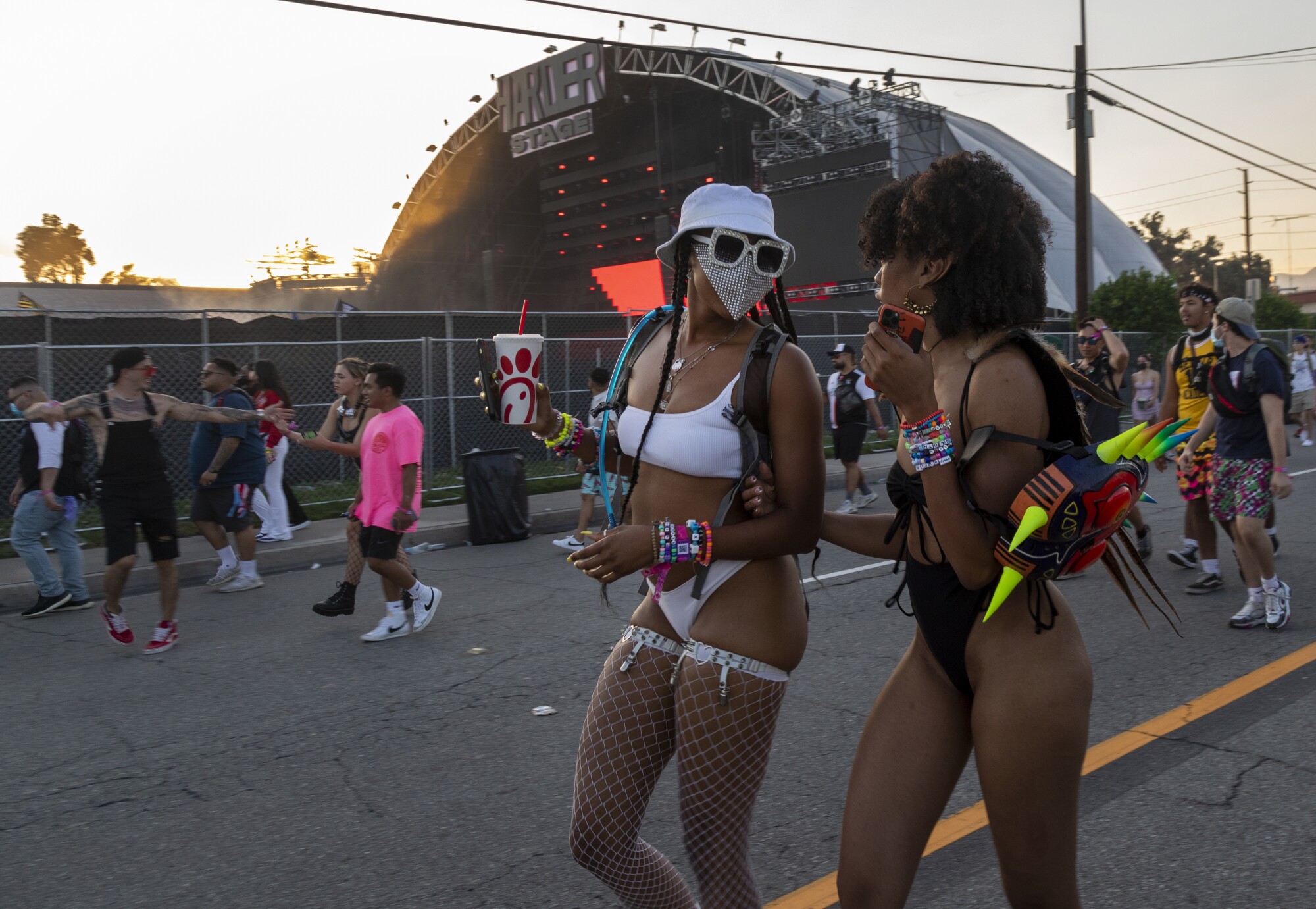
Concertgoers at the HARD Summer music festival on July 31, 2021.
(Gina Ferazzi / Los Angeles Times)
Based on the end-of-2021 stats, Pollstar expects the summit 100 tours of 2022 to sell around 65 one thousand thousand tickets, which would put them 12% above even the windfall year of 2019. Adele's upcoming Las Vegas residency is probable to suspension records.
"After the tremendous losses of 2020, the industry has no sense of taste for another shutdown. There would be extreme resistance to that," Waddell said. "There is so much work planned that there are very real shortages of gear, labor, transportation and available dates."
Even beyond the economic science, "I feel like there is newfound respect for the value of the alive affair, from fans to artists and those who work in the business," Waddell added.
Companies made new bets on alive music in 2020, similar the opening of YouTube Theater at SoFi Stadium in Inglewood. Closed spaces like the How-do-you-do Lid and Bootleg Theater were revived equally the Goldfish and 2220 Arts + Archives, respectively.
But fans and artists remain justifiably nervous. Stevie Nicks canceled her 2021 dates out of pandemic-surge fears. Live Nation'south stock, having rebounded from 2020 lows, wiped out most of its fall 2021 gains in simply the last month. NBA game cancellations, in a grim echo of 2020's pandemonium, are again spooking indoor crowds. Some concerts — specially by boomer-friendly acts — experienced no-shows from cautious ticketholders, equally much as 20% in some cases.
Outdoor festivals are a bright spot, but Phillips worried that "people are just not rushing back into theaters. That portends to where we are with arena and smaller venue shows. I'm not seeing the forcefulness and resiliency of box office for many headline artists.
"I go why festivals are flourishing, because there's space outdoors," he continued. "But you're starting to see new restrictions in the U.K. Even if isn't lockdowns again, the fear of it slows growth, and it volition take a piffling time before consumer confidence is restored."
While the Delta wave initially gave intermission to fans and promoters who had hoped for "Summertime of Dearest"-style delirium, outdoor festivals like Lollapalooza and HARD Summer proved to be relatively safe environments for fans to cut loose. It was a build-the-plane-equally-you-fly-it kind of scramble for acts to secure tour dates, though.
"We had to rebook dates three or four times," Rüfüs Du Sol'southward Lindqvist said. "It was really challenging to lock in outdoor venues with double the bands going out." The band required vaccines and masking for its crew. "I tin can't imagine the juggling it took for our tour and production managers," he said.
"The logistical challenges of touring during this pandemic have been massive," UTA's Clayton agreed. "Nosotros were all figuring out the safe protocols for the commencement time. It was very difficult for promoters to rent enough stagehands and venue staff, and those bug became magnified for tours that were requiring vaccinations."
After two years, when even industry giants similar Coachella bowed to COVID's evolving week-to-week threats (it'southward now scheduled for an April 2022 render), new events like Goldenvoice's This Ain't No Picnic and the inaugural L.A. edition of Barcelona'southward Primavera Sound are locked in for next year.
"Relief, that would be the discussion," said Alfonso Lanza, the co-director of Primavera Sound, which will make its long-postponed L.A. debut in September at L.A. State Historic Park in Chinatown, with headline sets from Lorde, Nine Inch Nails and Arctic Monkeys. "We tried in 2019, then 2020, then 2021, and it finally looks similar 2022 is our twelvemonth."
For local acts who waited out the pandemic as dear L.A. independent venues closed or lost staff, many in the scene desperately sought piece of work elsewhere or reimagined their creative futures.
When Thea Martre, the vocaliser and guitarist for the local indie-rock act Fox Violet, took the stage for the first time in a yr-and-a-one-half in December at the Troubadour, she was "pretty emotional, only in a lovely way. Information technology was a full-circle moment," she said. "A lot of sad things happened; nosotros lost a bunch of venues similar the Satellite, which was a huge hub for the local scene."
But into the next year, she added, "I can see massive resurgence also. We know how frail it is."
That fragility was made clear this year for nonpandemic reasons as well.
The Astroworld disaster, where ten fans died in a crowd surge and hundreds more were injured during headliner and festival founder Travis Scott'due south fix, joins 2017's Road 91 Harvest shooting in Las Vegas, 2016'southward Ghost Ship warehouse burn in Oakland, 2003's Station nightclub fire in Rhode Island and the Who's 1979 Cincinnati evidence equally the worst concert disasters in the U.South.
Scott was slated to headline Coachella adjacent twelvemonth, aslope Rage Against the Auto, but outlets now report he will about certainly bow out. Lawsuits stemming from the incident seek amercement into the billions from promoter Alive Nation, security and medical firms, streamer Apple Music and guest star Drake.
"In the wake of Astroworld, we'll see more emphasis on crowd command and logistics around front-of-firm and general admission," Waddell said. "The industry ever responds to tragedy with more than safety measures. Nobody wants to run into this blazon of thing happen."
Just Phillips expects insurance and security costs to rise for big events, after two years of heavy income losses. "Even before Astroworld, you couldn't get COVID-19 liability coverage. You can't throw more obstacles at an industry than COVID-19 and Astroworld. It's a perfect storm."
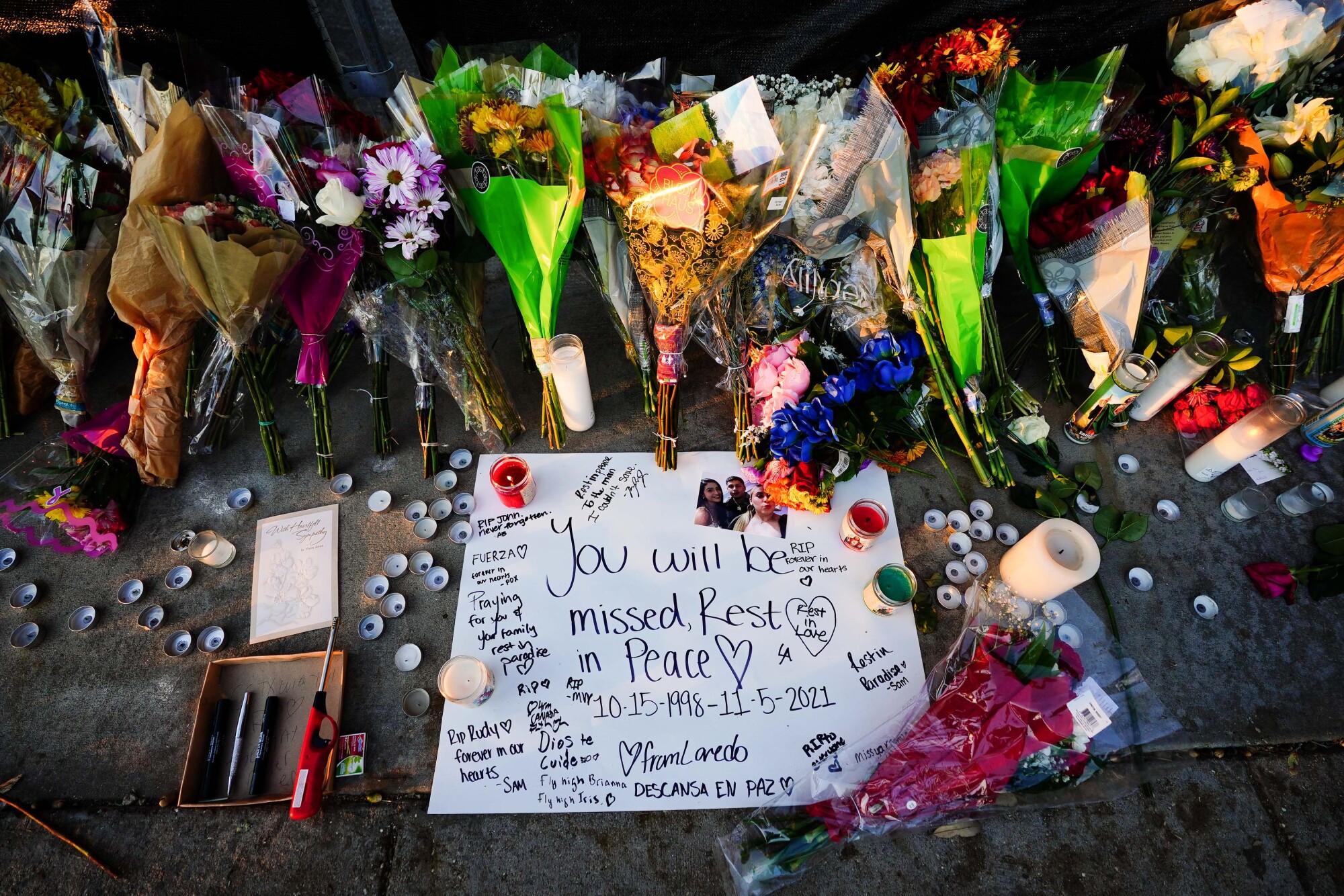
A makeshift memorial outside Houston's NRG Park commemorating the victims of the Astroworld Festival tragedy.
(Alex Bierens de Haan / Getty Images)
The new year of live music will likely be neither fully liberated from the pandemic nor equally dreadful and unsure as the last two years take been. Omicron is all just guaranteed to bring a new wave to the U.S.; vaccine boosters and new medicines could keep information technology navigable for the live industry though. Few in the industry or government seem eager to reinstate shutdowns around live events.
No one in live music has whatsoever illusions almost the possibility that things tin get haywire. But even the nigh grizzled promoters go out 2021 with some crusade for optimism for next year.
"Nosotros'll need to adapt to any measures, simply the feeling is almost normality. Big fests have happened in us. Possibly by the time of our fest in September, information technology'll exist fully normal," Primavera Audio's Lanza said. "Nosotros're humans — we went ii years without live experiences, and nil substitutes for that."
Source: https://www.latimes.com/entertainment-arts/music/story/2021-12-16/covid-astroworld-omicron-live-music-concerts-2021
Post a Comment for "When Will There Be Concerts Again"